Dyson Bathroom
I n the summer of 2005, a Chicago marketing consultant named George Campbell received a tantalising call from a headhunter. Was he open to an interview at Dyson? The company was secretively preparing to launch a new appliance, and it needed a sales strategy for the US: that was all the headhunter would divulge. Campbell was excited; he saw Dyson as "a company with the iconic quality of Apple, and an ability to take a basic product like a vacuum cleaner and make an 80% margin on it".
He went along to Dyson's office, a factory-like space with lofty ceilings and timber beams next to the Chicago river. In his first few conversations, he recalled, they wouldn't even reveal what the product was. Finally, Campbell was told in strict confidence: it was a hand dryer. And he'd thought he was joining Dyson for the glamour. "My heart dropped to my stomach."
The Dyson Airblade, released in 2006, was no ordinary hand dryer. The first model – which asked for dripping hands to be inserted into its frowny mouth – had a curvilinear form and brushed silver body. It looked so futuristic that it was used as set dressing on the Star Trek reboot in 2009. Inside the dryer, the air blew at speeds exceeding 400mph; its filter claimed to capture 99.95% of all particles 0.3 microns or bigger in size from washroom air; it cost about £1,000. The Airblade was not the first high-speed dryer, but its luxe appeal and Dyson's brash marketing revolutionised the restroom universe; more and more, the hand dryer began to seem like a vital accessory to class up a joint. After the Airblade's launch, a battle began to boil, pitting the dryer industry against the world's most powerful hand-drying lobby: Big Towel.
Public bathrooms offer three primary options to dry a pair of wet hands. First, there is the venerable crisp-pleated paper towel. Second, the old-style warm-air dryer: those indestructible metal carapaces that, through their snouts, breathe down upon our hands. And finally, the jet dryer sub-species of the sort Dyson makes, whose gale-force winds promise to shear away every drop of moisture rather than slowly evaporating it. In the quest to dominate the world's restrooms, Campbell discovered, Dryer v Towel is a pitched contest of business strategy and public relations. "Expect to be lied to a lot," Campbell told me. "It's almost like the cola wars. You have Pepsi v Coke, and you have hand dryers v paper towels."
The chief battleground for this duel is public hygiene. Science has tried and failed to come to a consensus about the hygienic superiority of one product over the other. Even so, the paper towel industry has funded or promoted a rash of studies claiming that hand dryers turn bathrooms into mosh pits of pathogens. These results almost always make news. Any sort of health scare is a gift to a journalist – an opportunity to write viral headlines such as "Hand dryers are blowing bacteria all over your hands" or "Hand dryers are germ-flinging bullshit".
Once these fears have been mongered, their spread is irresistible. Last year, a student of microbiology in California stuck a petri dish inside the maw of a Dyson Airblade for three minutes and then incubated it. Over the next 48 hours, the fungi and bacteria deposited on the dish by the dryer multiplied, growing into thickets of grunge. When she posted a photo of the dish on Facebook, 500,000 people shared it in a week. Dyson piped up, protesting that the experiment's methodology was too vague to be meaningful, but it went practically unheard.

As an invention, the paper towel isn't much older than the hand dryer; the Scott Paper Company, based in Philadelphia and now owned by the tissue giant Kimberly-Clark, developed the first restroom towel in 1907, while the Airdry Corporation, in New York, patented the earliest "drying apparatus" in 1922. For most of the 20th century, the towel was the more dominant product. Dryer companies, by and large, just made dryers; their budgets were small and their influence limited. The biggest manufacturers of paper towels were behemoths such as Kimberly-Clark or Georgia-Pacific, which also produced a vast range of other items. Their pockets were deeper, their leverage over customers greater.
Only after Dyson arrived and other dryer firms shook themselves awake did the contest acquire any edge at all. The numbers still weigh heavily in favour of Big Towel. In 2020, according to the market research firm Technavio, the world will buy roughly $4bn (£3bn) worth of multi-fold paper towels, of the kind most commonly seen in public bathrooms; the same year, hand dryer sales will jump to $856m, having grown 12% every year since 2014. Between 2012 and 2020, a Dyson spokesperson reckoned, hand dryers will have sucked $873m out of paper towel revenues. This is why, he argued, Big Towel launches such regular broadsides at hand dryers.
For those making the decisions to purchase them, paper towels and hand dryers compete on other dimensions as well: cost, for instance, or eco-friendliness. But the public mind obsesses most over the cleanliness of the public bathroom. So many different kinds of people tramp in and out of these spaces, says Ruth Barcan, a cultural theorist at the University of Sydney, that we have become paranoid about them – "about what others might or might not do, leave or not leave, clean up or not clean up – about who's the same as us or not the same as us".
The holy grail for such phobists is the contactless restroom. In the industry, people speak with shining eyes about this ideal chamber, where our hands need not touch anything that other hands have defiled. Already, we enter some airport bathrooms through a brief switchback of walls, so that we don't ever grasp a door handle. Once inside, sensors can eliminate the need to yank the flush, turn the tap, jab at the soap dispenser or pull a paper towel from the dispenser. The modern hand dryer, with no buttons to push, ought to fit neatly into this fantasy of the zero-contact loo. Instead, towel companies are convinced that dryers are the filthy exception to the rule, and that the singular safe item to touch in a public restroom is an old-school leaf of rough, thick paper.
T he patent diagram for the very first hand dryer shows a nozzle projecting horizontally out of the wall, as if someone were sticking a gun into your ribs and demanding your wallet. You pressed down on a foot pedal to activate a puff of air, which evaporated the moisture on your hands. In 1922, in a journal called Hotel World, the American Zephyr Company bragged that its "warm air towel" could dry your hands in 36 seconds. A full seven decades later, dryer developers had managed to shave just six seconds off that time. The design stayed essentially the same: the nozzle now glanced downwards, and the foot pedal yielded to a round metal button, but it was still a motor driving a fan that whipped air across a heating element. This was not an industry in any hurry to innovate.
Through most of the 20th century, it was still uncommon to find a hand dryer in a public bathroom. When the British actor Jonathan Routh published the first edition of his Good Loo Guide ("Where to Go in London") in 1965, he singled out the device for mention every time he found one. Only five toilets, out of more than a hundred, held hand dryers – of the pedal-operated kind that, in the 1965 movie Help!, inhale the jacket sleeves of Ringo Starr and Paul McCartney. Mostly, Routh encountered towels of cloth or paper, and quite often, he had to pay to use these products. ("Do loos ever advertise their attractions?" he wondered, while extolling the virtues of the splendid restrooms of Hyde Park in the 1968 update. "Has anyone ever seen an ad saying 'Just arrived – new free electric hand-drier at the so-and-so loos.'") Even in the third and final edition of the guide, released in 1987, I counted more instances of electric razors, armchairs and pre-pasted disposable toothbrushes than of hand dryers.
For decades, the pre-eminent hand dryer manufacturer was World Dryer, a company so closely associated with the product that many people assumed its founder, George Clemens, had invented the thing. In 1948, when Clemens set up World Dryer near Chicago, a post-second-world-war wood shortage was causing a shortage of paper towels. Clemens released the Model A hand dryer, an enamel-white shell with a shiny round button, in 1951. Even as a succession of owners bought and sold the company, the Model A and its variations remained World Dryer's stock in trade – its All-Stars sneaker, its Tabasco sauce. For years, the tank-like Model A was the apex of possibility – the best dryer on the market, now and for ever.

Even World Dryer seemed to believe that. In 1989, when Scott Kerman joined World Dryer as a salesman, it wasn't a very ambitious company. It was unfair to judge it in hindsight, he conceded, but "back then, if someone were to go ask for money for R&D, he'd have been told: 'Who the hell needs a better hand dryer?'" Nothing revolutionary seemed to be happening anywhere. Kerman remembered how, in the autumn of 1997, the president of a rival company, Nova Dryer, tried to poach him. He was flown out to Montreal, where Nova was based. The president took him into a dark office, turned on the lights and revealed an object with a sheet covering it.
"This is your future, whether you like it or not," the president said dramatically, then whisked away the sheet.
It was a slightly quieter, slightly more efficient, slightly smaller hand dryer. (Kerman didn't take the job.)
Still, customers bought them. Kerman pitched his products as inexpensive and durable. In the 1970s, McDonald's installed World Dryer models in all its restaurants across the US. "That was a big win," he said. "That was two by thousands" – industry-speak for a dryer each in the men's and women's restrooms, multiplied by thousands of locations.
The fundamental superiority of paper never looked to be in doubt, though. With paper, you didn't have to wait restlessly for half a minute for the dryer to finish its bloviation. You didn't have to fear a malfunction: no air at all, or infernally hot air, or even an explosion of the kind that pours flames upon an unlucky, damp-handed soul in the 1993 film Ghost in the Machine. You could dab at spots on your tie, or dry a washed face, or wipe sweat from your brow. In a famous sequence, an angry restroom tap drenches the front of Mr Bean's trousers. The paper towel dispenser is empty. His only solution is to climb on to a bin and pump his pelvis around near the muzzle of a World Dryer Model A. He wouldn't have been caught humping the hand dryer if the dispenser had been full. Paper is nimble that way.
The Airblade was designed to be different from your grandfather's hand dryer. Beneath its ribs is a compact digital motor, of the kind Dyson specialises in; it manufactures 21m of them every year in its plant in Singapore. In 2003, when Dyson began developing the Airblade, the concept wasn't absolutely new. In Japan, throughout the 1990s, Mitsubishi's Jet Towel had used a fast, cold stream of air to strip water off hands, but the model hadn't spread widely in the UK or US. In 2001, an American firm, Excel Dryer, had launched the Xlerator, a high-speed device committed to drying your hands in 12 seconds. A couple of years later, testing an idea for a different project, a Dyson engineer slid his hands past a pane of air and felt its potential.
A former Dyson employee described the gestation of the first Airblade. He told me about the set of prosthetic hands, modelled on those of a Dyson scientist, that were used to test early prototypes. The prosthetics were of limited utility; they couldn't simulate the range of human hands, some of which are hairier or better-moisturised than others. A single individual could only be an Airblade guinea pig for so long before her hands, after repeated use, became chapped and parched, so a call went out across the campus for volunteers to come and rinse and then dry their hands. The Airblade team wrestled with the philosophical question: how dry is dry? They decided that a pair of hands ought to bear just 0.1g of moisture or less after a 10-second squall from an Airblade. "If you were at 0.3 or 0.5, that was a fail." Testing for hygiene, recruits first massaged some raw chicken, so that scientists could see how many microbes remained on their hands after they were washed and dried.
All this R&D must have felt like dynamic research, compared to the earlier listlessness of the industry. In its intent to science up the basic act of wiping your hands, the older, warm air dryers became a symbol of what Nicholson Baker, in his novel The Mezzanine, called "futurismo progress". Like paper clothing or food in capsule form, Baker wrote, hand dryers felt like a relic of some earlier moment of techno-utopian thinking. They embodied a wide-eyed devotion to machines, which, as the years passed, started to seem sweet and misbegotten. Many of the photos posted on Instagram's HandDryers handle (7,419 followers) or on Facebook's Group for People Who Appreciate Quality Hand-Dryers (8,953 members), have a forlorn quality to them. The dryers hang alone from a wall like little decommissioned robots; the more ancient models, in particular, look as if they are dreading their own impending obsolescence. The sadness is of futurismo unrealised. If Mitsubishi and Dyson hadn't blown new air into bathrooms everywhere, paper might have kept comfortably winning the great hand-drying wars well into our time.
I f there is such a thing as a truly perfect public restroom, it is the unmemorable one. It should be free of calamities, of course: the puddle upon which you slip and sprain your ankle, the overflowing toilet bowl, the broken stall door that leads to the embarrassing intrusion. But it should also preclude minor hassles: the five-second wait for a free sink, the malfunctioning hand dryer or the empty paper towel dispenser. Our bathrooms at home feel warm and familiar, like an extension of the rest of our domestic space; leaving aside its purpose, a visit there feels no different to nipping into the bedroom to pick up a book, or into the kitchen for a snack. The least the public restroom can do is slide in and out of our day as unobtrusively as possible.
In his first year with Dyson, George Campbell toured the restrooms of the US. He visited 47 states, asking his distributors and expanding fleet of salespeople to take him to any facility they could think of, so that he could research his market. He went to stadiums and universities; he went to airports, where the staff escorted him in through a backdoor to skip security lines; he went to cinemas, museums and hospitals; he went to Disneyland. He didn't keep score, but he reckons he ran into hand dryers in one out of every 20 bathrooms. In Britain, the ratio was only a little better, hand dryer veterans remember: one bathroom in every 10, perhaps. Campbell felt he was strategising for a virgin market. He would tell his salespeople: "The bad news is: we really don't know what we're doing. But the good news also is: we really don't know what we're doing."
There are two sorts of audiences for a hand dryer sales pitch: architects, who can be persuaded to put dryers in their new buildings, and facilities managers of existing restrooms, who might be converted from paper to air. They are tough crowds. "With architects, the dryer is the last thing to be installed in a building," an old hand told me. "It is the last thought they have. And it's given so little attention." A facility manager, Campbell said, has a thankless job. "He's the department of complaints," Campbell said. "Nobody goes up to him at the end of the day and shakes his hand and says: 'Thanks for a great day. Nothing went wrong.' The CEO of the company doesn't give a shit about his job. The CEO only cares if his wife goes into the bathroom and is pissed off because there are no paper towels." As long as no one whinges about anything, inertia will keep things the same. "The guy's world revolves around: 'No one hated me today.'"
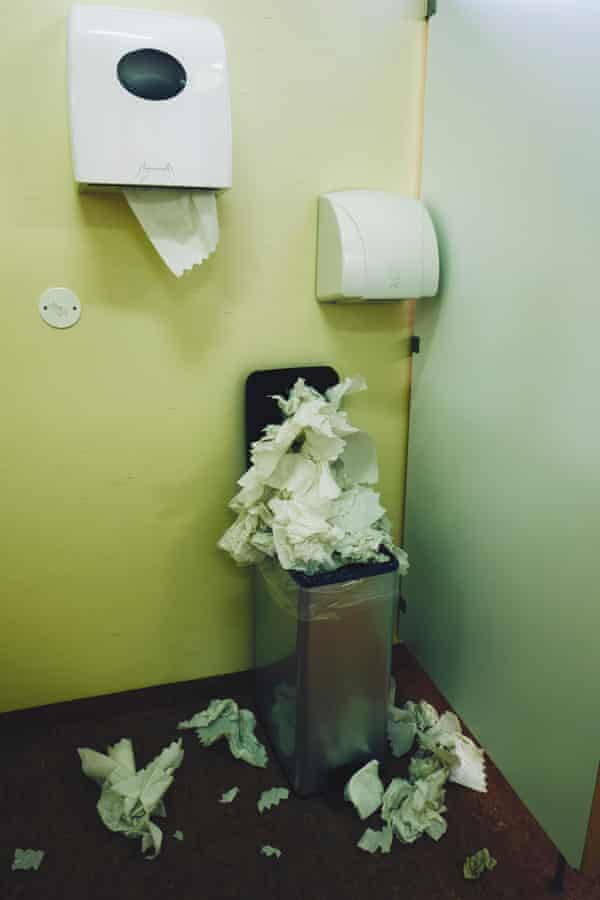
Fortunately for hand dryer companies, paper towels can be troublesome. There's the hassle of monitoring the dispensers, keeping them filled and keeping the wastebaskets empty. There's the miasma of litter: towels tossed onto the restroom floor, where they grow damp and muddy, dissolving into something like primordial ooze. People often flush paper towels down toilets, plugging them up; a facilities manager at the University of Tennessee, which recently switched out all its paper towels for about 700 hand dryers, told me that he was saving $100,000 every year by not having to plumb and unclog toilets. Sofidel, one of the world's largest tissue manufacturers, has even had to develop a product that disintegrates quickly in water, said John Phillips, Sofidel UK's country sales manager for what the industry calls its "Away-From-Home" segment.
In his 15-year career, Phillips has come across other problems as well. At one British university, students were purloining towels from their dispensers, so Sofidel provided dispensers with locks. "We went there one day to test it out. The students stole the tissues along with the dispenser." Arson is another bizarre concern. Tolis Demertzis, an executive with World Dryer, visited an American community college last year, ready to wow his customer with calculations showing how hand dryers could save money. "They didn't care. Someone was taking their wastebaskets full of towels and lighting them on fire," Demertzis said. "They lost four restrooms before they caught the individual. That's why they wanted to eliminate paper."
But towel theft and wastebasket conflagrations are peripheral worries. Among the hand dryer's advantages, the one that sings out clearest is the money it can save. It's the first thing Matt Anderson mentions to clients. Anderson is the managing director of the UK arm of Veltia, a Spanish hand dryer company. "I'll tell them that the upfront cost of one of my dryers is probably £300 or £400. Then it'll take around £5 a year in electricity to run," Anderson told me. "Otherwise they'll be buying thousands of pounds' worth of towels a year." Like other air men, Anderson seemed astonished that the paper towel business model could even exist in the age of the high-velocity air. One dryer salesman spoke admiringly of it as a dodgy subscription plan, as if the paper companies were running some long con to print themselves money.
Ecologically, too, the hand dryer is a wiser choice. Even a recycled paper towel was at some point a slice of tree pulp, and after being used in a restroom, it's impossible to recycle further. "Even my mum thinks that we simply cut trees," Fanis Papakostas, the chairman of the European Tissue Symposium (ETS), told me with a sigh. But the industry has shrunk its environmental footprint, he said. The ETS represents the manufacturers of 90% of European paper tissue production, and almost all their raw material comes either from recycled paper or from renewable forestry, by which young trees replace their older colleagues that have been fed to the mills.
There's a limit, though, to how green a paper towel can be. "OK, you have renewable forests," Anderson argued. "OK, maybe your manufacturing plant now uses solar or whatever. But they still have to be transported. They still have to come to the UK in container ships, and they still have to finally be buried in a landfill." With a devout look on his face, he said he had seen some dryers run for a decade and a half: "They just last and last. There's nothing more sustainable than that, is there?"
In 2011, Dyson funded a peer-reviewed study at the Massachusetts Institute of Technology, where scientists summed up all the environmental impacts of the manufacture, use and demise of paper towels, warm hand dryers and high-speed dryers. They assumed that we use two paper towels each time we wash up, that the fastest dryer runs for 12 seconds, and that the slowest for a half-minute. Hard as they were to compare, the study was confident that high-speed dryers were kindest to the environment. When every inch of the process is factored in – mining the ore to make the metal of a hand dryer, making towels out of trees, transporting these products, binning them – paper towels can generate as much as 70% more emissions than the most efficient hand dryer on the market.
Faced with these inconvenient truths, what is an industry to do? At Georgia-Pacific, an Atlanta-based pulp and paper giant, Mike Adams hears about cost and sustainability all the time. Adams is the president of a division that supplies other businesses with its products. He can be indefatigable in explaining how his supply chains work with renewable forests, but he can't deny that the soiled paper towel's fate is still to rot within the earth. "The free market hasn't figured out a way to recycle these towels in a way that's sustainable," he said. "We've run some experiments on recycling them – you collect 'em, you put 'em in a green bag, they go to a recycling plant, they come back as copy paper – but it isn't a commercial process yet." He paused, then said with hope: "I think there will be a day when we see towels recycled."
U ntil then, paper companies will be most vocal about hygiene – the one theatre of war they feel they can still rule. The earliest study to compare drying methods for residual bacteria was published in 1953; since then, dozens more have been written, and the pace picked up particularly after Dyson splashed down into this market. Most studies address two central questions: do our hands come away more or less germy after using a dryer as opposed to a paper towel? Do the dryers disperse bacteria and viruses through the restroom, like autumn breezes gusting leaves across a lawn?
Against all the sheaves of studies funded by one side or another, there has only been one truly independent research project of note. It was conducted by the Mayo Clinic in 2012, and its authors recommended that paper towels be preferred in places where "hygiene is paramount, such as hospitals and clinics". This isn't a premise that dryer companies often contest; their fight concerns the regular public restroom, where they argue that hand dryers are no more or less sanitary than paper towels. No unanimous answers have emerged, but in all the studies funded by the European Tissue Symposium or designed by one of the microbiologists it retains as consultants, the results have turned out, perhaps unsurprisingly, to be pro-towel. Papakostas, who has chaired the industry body since 2017, couldn't tell me precisely how many studies ETS has been associated with. Definitely a couple during his tenure, he said. I counted at least seven others since 2006, the year Dyson launched its Airblade.
It isn't easy to know what to make of these studies. Many undergo peer review, but an experiment can be structured in a way that favours a particular outcome and still be valid science. I asked Papakostas if ETS played a part in designing the experiments in these papers. It didn't, he insisted. When ETS funds a study, it asks for some information: "The title of the activity, the reason and key outline." Scientific protocols – the design and implementation of experiments – are never discussed, he said. "Our member representatives are mostly business-background people. Details of a protocol are not an interesting subject to them."
The minutes of two meetings of an ETS task force reveal avid discussion of an upcoming funded study and ways to disseminate its results. The meetings, held in November 2016 and January 2017, didn't get into the study's protocol, as Papakostas said. But they did show how intimately ETS worked with the University of Leeds researchers undertaking the project. In the study, published in the Journal of Hospital Infection, the scientists collected bacteria across a dozen hospital restrooms in the UK, France and Italy. (They mentioned, in their paper, that they used a Dyson vacuum to hoover up dust, to take it back to the lab for analysis.) They found "significant differences" in the contamination levels of washrooms with jet air dryers and those with paper towels.
During the meetings, a Kimberly-Clark representative updated the others about early progress. (Kimberly-Clark did not respond to multiple requests for comment for this story.) The rep was involved in contacting other scientists to secure their participation, and the task force treated her as its main point of contact with the lead scientist. The experiment hadn't yet begun, but ETS was already planning a media strategy for the best-case scenario: the discovery of antibiotic-resistant bacteria in washrooms with hand dryers. They were confident they would have something to communicate.
Duomedia, a PR firm, presented ETS with a plan to beat the drums over the study's prospective findings. "'What' and 'If' are two words as non-threatening as words can be," said one slide in their presentation. "But put them together … and they have the power to haunt you for the rest of your life: what if?" The budget for the media plan ran to €30,000. "Do you know what can threaten YOU?" ran a proposed line of copy for an advert. Among other schemes, Duomedia outlined an animated story – a day in the life of "Sally the super bug", in which people transmit a methicillin-resistant staphylococcus aureus bacterium from a hospital washroom, to a patient's room, to an elevator, to a cafeteria. "What an adventure, and it was still only 10 o'clock in the morning." Towards the end of the presentation, Duomedia recommended a "more intense pro- and re-active approach versus Dyson".
Hand dryer firms have sponsored studies of their own, engaging as closely with those researchers as ETS did with its own. In fact, in one Dyson-funded paper, published in 2011 in the peer-reviewed Journal of Applied Microbiology, a Dyson scientist named Toby Saville was one of four authors arguing that the Airblade was better at reducing bacterial transfer than the older models of hot air dryers. But ETS's studies have been more numerous, and they have been more adroit in providing terrifying headlines. "Hand Dryers Are Blasting E-coli And Faeces Particles Around Bathrooms, Study Finds," HuffPost UK wrote of the Leeds study. The tech web site Gizmodo, covering the same study, called jet dryers "basically germ cannons".
These were strange conclusions, because the Leeds study's data was quite equivocal. The scientists sampled six different parts of the restrooms they visited. Only in two of these locations – on the floors, and on the surfaces of hand dryers or towel dispensers – did washrooms with dryers show appreciably more bacteria than those with paper towels. Even then, those higher numbers were half of those typically found on our own bathroom floors at home. Unless you were planning to caress the floor, it didn't seem to matter. But the paper and its attendant press coverage had their effect. Matt Anderson, of Veltia, called it an example of Big Towel's "scare-mongering … They've really ramped it up over the past year or so, and I know people who say it's hurt the sales of dryers."
E arlier this year, I met Keith Redway, an emeritus professor at the University of Westminster and the world's most prolific author of pro-towel studies. Redway, a microbiologist, published his first paper on the subject in 1994, on commission from the Association of Makers of Soft Tissue Papers. In his most recent experiment, published in 2015, Redway and a colleague tested how widely paper towels, hot air dryers and jet dryers could disperse viruses. Redway's wife drew life-sized outlines of a man, a woman and a child on a piece of stiff cardboard. Then the scientists put on gloves, soaked their hands in a virus-rich broth and dried them with one of the three options. Petri dishes of agar affixed to the cardboard family, which was positioned at different distances of up to three metres, captured and revealed any dispersed viruses. Not surprisingly, the high-speed Dyson was found to be slinging viruses the furthest.
Wasn't the premise of the experiment a far-fetched one? I asked Redway. Surely no one in a normal restroom bathes their hands in a viral solution before moving on to a jet dryer? But this was just a model, Redway said, and they had treated all three drying devices the same. "In theory, you need one virus or one bacteria to cause an infection. In practice, it's more than that," he said. "There's some bacteria you only need 10 cells to start an infection, like dysentery."
The course of the hygiene debate fluctuates between levels of idealism and pragmatism. Redway thinks restrooms should be as free of risk as possible. Dyson's scientists argue what's important is a realistic assessment of risk. We come into contact with germ-infested surfaces all day, every day, but we don't keep falling catastrophically ill. What's important is that people wash their hands with soap and dry them well. "No hand-drying method is good … if the hand washing is not properly done," said Salomé Gião, a microbiologist on Dyson's staff.

An argument like that stirs Redway up; he appeals to common sense and our knowledge of human nature. In survey after survey, most visitors to public bathrooms confess that they don't wash up thoroughly. "They don't use soap, just a bit of water," Redway said. Then, when they stand in front of a hand dryer, "whatever's left on their hands, which could be fecal material if they haven't washed them properly, is blown everywhere". A paper towel prevents that. Then too, Redway added, if there's a queue for the hand dryer, people may just leave with wet hands, which pick up and transfer far more germs than dry hands. The question then becomes: how much do we trust the hand-washing and hand-drying inclinations of those who have preceded us into a washroom? Our loo culture reveals our habitual laziness, our perpetual hurry; it is our own tendencies, rather than hand dryers or paper towels, that must be blamed for our germ-ridden restrooms.
Redway sits on ETS's panel of scientists, which meets once a year in Leuven, Belgium; ETS pays for the trip, and it pays them all an honorarium. Sometimes Redway presents at conferences on ETS's behalf, in Nice or Barcelona or Geneva, and ETS pays him on those occasions as well. But he insists that his experiments aren't influenced by this relationship: "I'm not here to sell paper towels, whatever Dyson says." He wouldn't reveal how much his honoraria have added up to, over the years. "It's not very much. There's nothing to hide, really. And I wouldn't want that getting back to Dyson."
The rancour between Redway and Dyson has erupted into the occasional strange confrontation. Once, the Dyson microbiologist Toby Saville snuck into a Tissue World conference under an assumed name, so that he could watch a talk in which Redway rubbished Saville's own research. "It was pretty incendiary," Saville told the Verge three years ago. "He was whipping the crowd into a bit of a frenzy about it." For his part, Redway claims he has had three letters from Dyson over the years, telling him that his studies are flawed and that he shouldn't be talking about them at conferences. He grew indignant: "They have no right!" He told me how, at an Interclean trade show in Amsterdam several years ago, a team of Dyson executives walked into his presentation and sat in the front row. "My researcher was a bit nervous. I said: 'Don't worry, we'll defend ourselves.' I was disappointed they didn't ask any questions."
One of the Dyson executives present remembered the incident. "There was somebody from ETS at the door, taking names as people came in," he said. "Her face was a picture when we showed her our Dyson badges. They tried initially to stop us from going in. We replied: 'So you're restricting us? That suggests you've got something really derogatory to say about us as a business.' Eventually they capitulated." The talk, he said, "was thinly veiled as something else, but it was really clearly a public attack on us to anybody who wanted to listen". He recalled one of his colleagues lobbing a question at Redway. "It was a pretty electric atmosphere for an industry symposium," he said. "They're usually pretty dull with somebody falling asleep in the background."
Redway keeps sounding the alarm about hand dryers, but he is frustrated that more people aren't acting upon it. "We've even got them here," he said, with a despairing gesture around the building of the University of Westminster. It reminded me of something George Campbell had said. In the Dyson offices in Chicago, where he once worked, the lobby washrooms had Airblades but also paper towels. "Even Dyson employees would go to the bathroom and grab a paper towel to open the bathroom door to get out of there."
I asked Redway what he would do if he went into a restroom and saw only a hand dryer.
"I've always got … " he began, then started digging through the pocket of his coat. A jingle of keys emerged, then some coins, and finally, a crumpled sheet of paper towelling.
I visited Dyson's campus in Malmesbury in Wiltshire in January, just as the company was being pilloried in the press. The founder, Sir James Dyson, had been a stubborn Brexiter back in 2016; three years later, as Britain was floundering in search of a way to leave the European Union, Dyson announced that he was moving his headquarters to Singapore. The two media officers I met must have been relieved that they needed to talk about hand dryers, not Brexit. They led me through the sights: a giant Faraday cage, to test devices for electromagnetic interference; an anechoic chamber to refine noise levels, so quiet I thought I heard my blood wash around my body; a lab to test filters. Every time we came a research area, we had to pause while the scientists threw grey shrouds over prototypes that I wasn't to see. The restrooms sported the Dyson Tap, the newest Airblade model, which costs almost £1,500. It is the one that sits above a sink and is shaped like a cartoon arrow; the tip of the arrow is a faucet and dispenses water, and the two tines of the arrowhead blow air. There wasn't a paper towel in sight.
When Airblades first began to pop up in bathrooms around Britain in 2006, the former Dyson employee recalled, "people didn't understand what they were. They thought it was a weird-looking urinal." The Airblades initially took aim at their cousins, the hot air dryers, but Dyson soon learned that if you have shelled out a few hundred pounds for one kind of dryer, you aren't likely to spend nearly a thousand more to replace it with another. So the company tried to storm paper towel territory, where it found itself a fight. The stream of scientific papers on hygiene quickened then, the former employee said. "We'd arm the sales guys with a crib sheet of facts to counteract them," he said. There were times, he remembered, when "we were mid-deal, and [the client] would then say: 'I've just seen the University of Westminster report. Sorry guys, I'm out.'"
At its most audacious, the hand dryer is an expression of faith in the mechanical – in the premise that no cubic inch of our day is too trivial to remain unimproved by technology. The wipe of a hand upon a square of natural fibre is an astonishingly ancient action; it is difficult to imagine prehistoric hunter-gatherers getting their hands dry in any other manner. The hand dryer's essential ambition is to break a human habit tens of thousands of years old, and to persuade us that the few times we dry our hands daily, for a few seconds every time, warrants a machine. It dares us to submit to its idea of modern life.
At Dyson, of course, there are no doubters. In a conference room, I met Stephen Courtney, the company's "concepts director" – a title that reflected his delectable job of dreaming up new products. It was Courtney who came up with the idea for the Dyson Tap, and he's now contemplating further moves: a hand dryer for the home, for example. "What if we made it super-quiet?" he said.
There are two new Airblades on the horizon. Courtney couldn't yet reveal much about them: "We've patented some things, but not everything, you know?" They'll look very different, he said. They will still hover above the sink, like the Tap, and they will be even more energy-efficient. Courtney's voice acquired the mystic excitement of a man promising not dry hands but salvation, and I remembered an illustration on the Dyson web site of two hands held below an Airblade V; the sheets of air were rendered like sacred light, so that the hands seemed to be reaching towards the just-ajar doors of heaven. "It's going to be really cool," Courtney said. "You're going to love it."
Source: https://www.theguardian.com/society/2019/apr/25/hand-dryers-paper-towels-hygiene-dyson-airblade